Walk a deal through Sherpa.

This is the whole arc, in the order it actually happens. A thesis becomes a target, a target becomes diligence, diligence becomes a close, and a close becomes a hundred days of work that either delivers the thesis or doesn't. Here's what Sherpa is doing at each point, and who's doing it.

Start with how your firm is actually built.

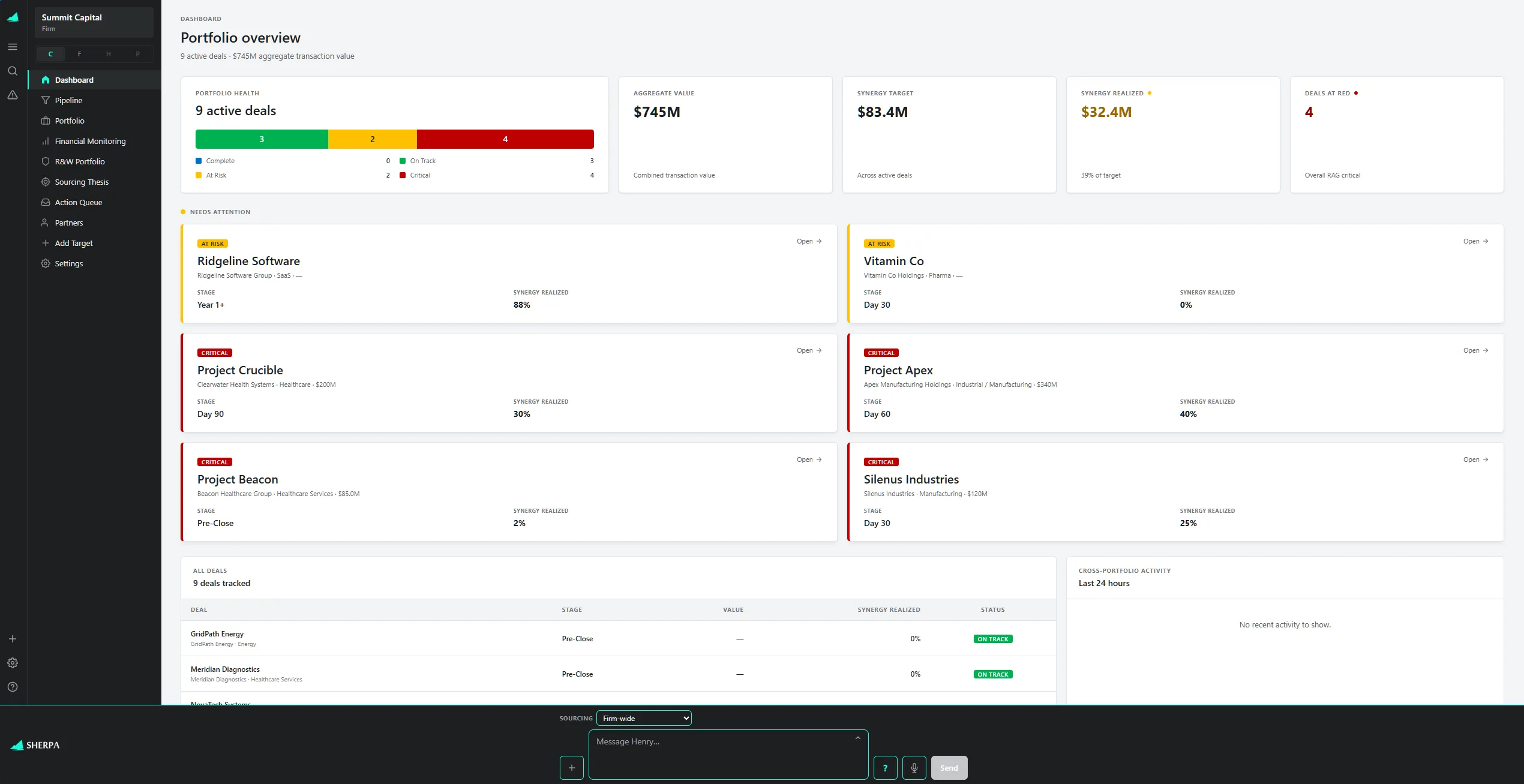
Before any of the deal work makes sense, Sherpa needs to know your shape, and it models the real one. Firm at the top, funds beneath it, holdcos under those, portcos at the leaves, with ownership percentage and investment date on every node. Not a folder structure pretending to be an org chart.

That matters more than it sounds. A deal happens at a portco, but its synergies belong to a fund's returns and its risk belongs to the firm. Because Sherpa knows which portco sits under which holdco under which fund, everything the deal work produces finds its way to the right level without anyone rebuilding a rollup in a spreadsheet. The work happens at the bottom. The picture assembles at the top.
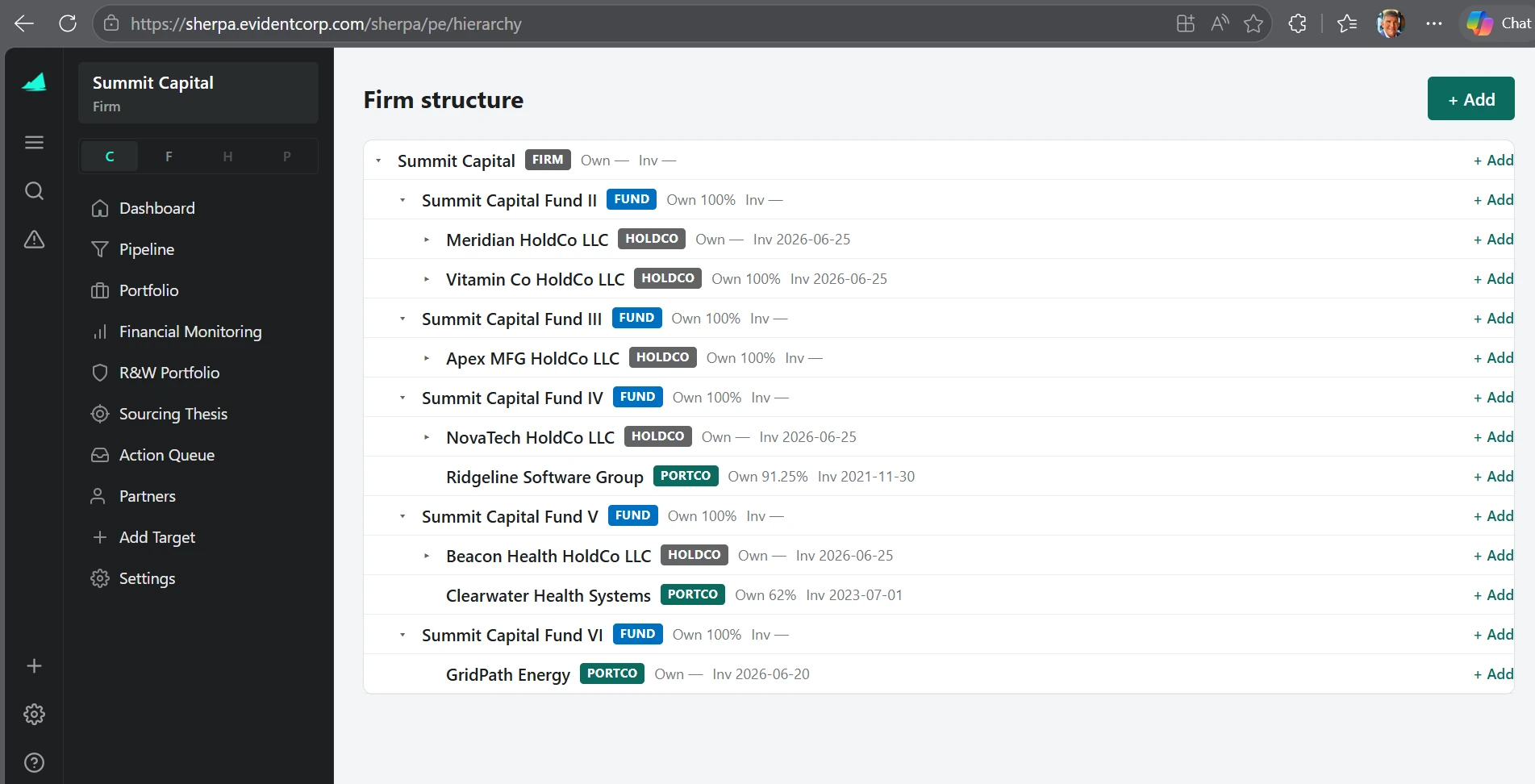
Sherpa firm structure view with funds, holdcos, and portcos, ownership percentages, and investment dates

A deal starts before there's a deal.

Every good acquisition starts with a point of view about what you're looking for. Sherpa holds that thesis as a live object rather than a slide from last year's offsite, and Henry works the pipeline against it, surfacing targets that actually fit and flagging the ones that only look like they do. He's reading your whole portfolio while he does it, so "does this fit" means fit with what you already own, not just fit on paper.

When a target survives that screening, you take it forward and the deal begins.


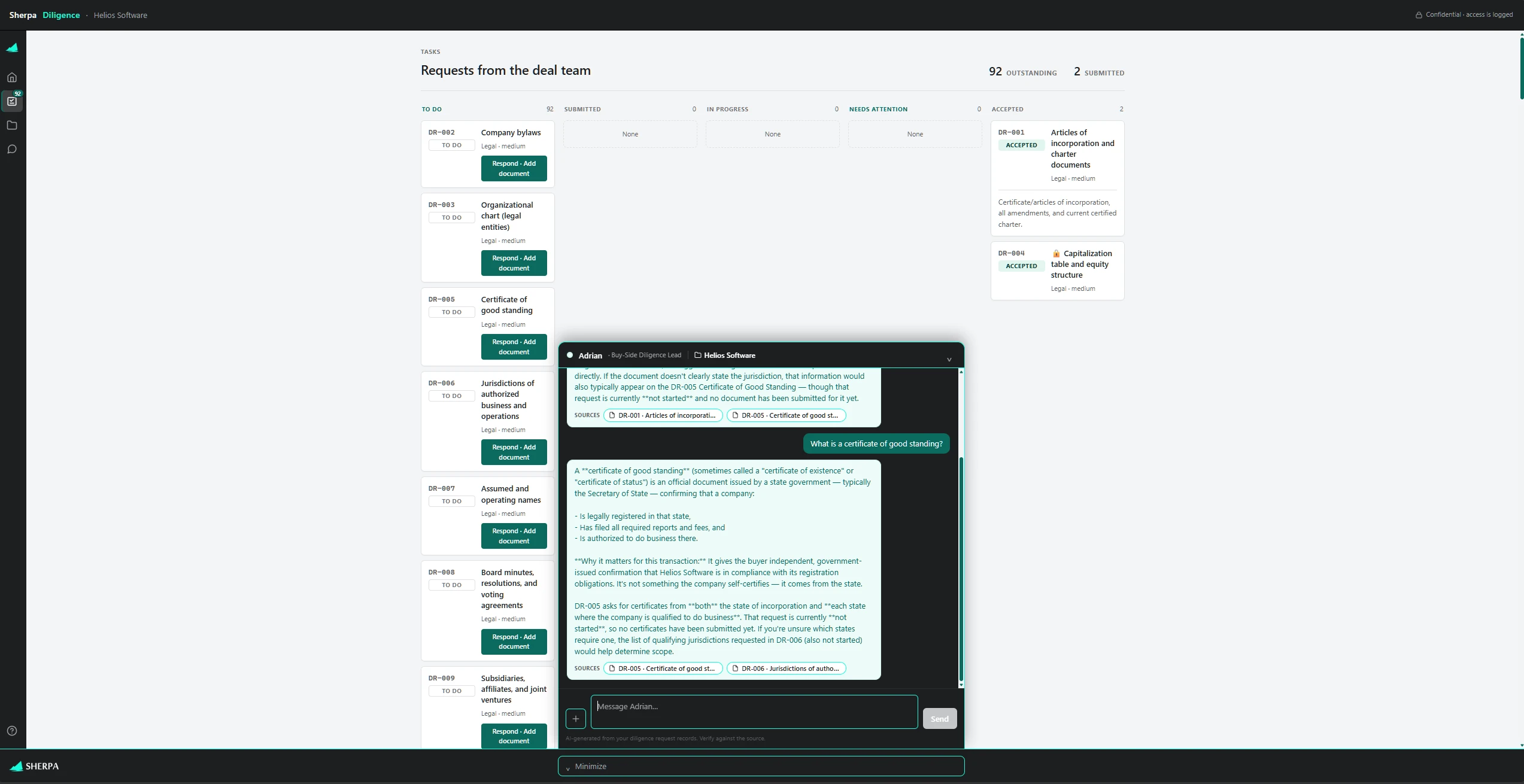
It's read every page. Ask it anything.

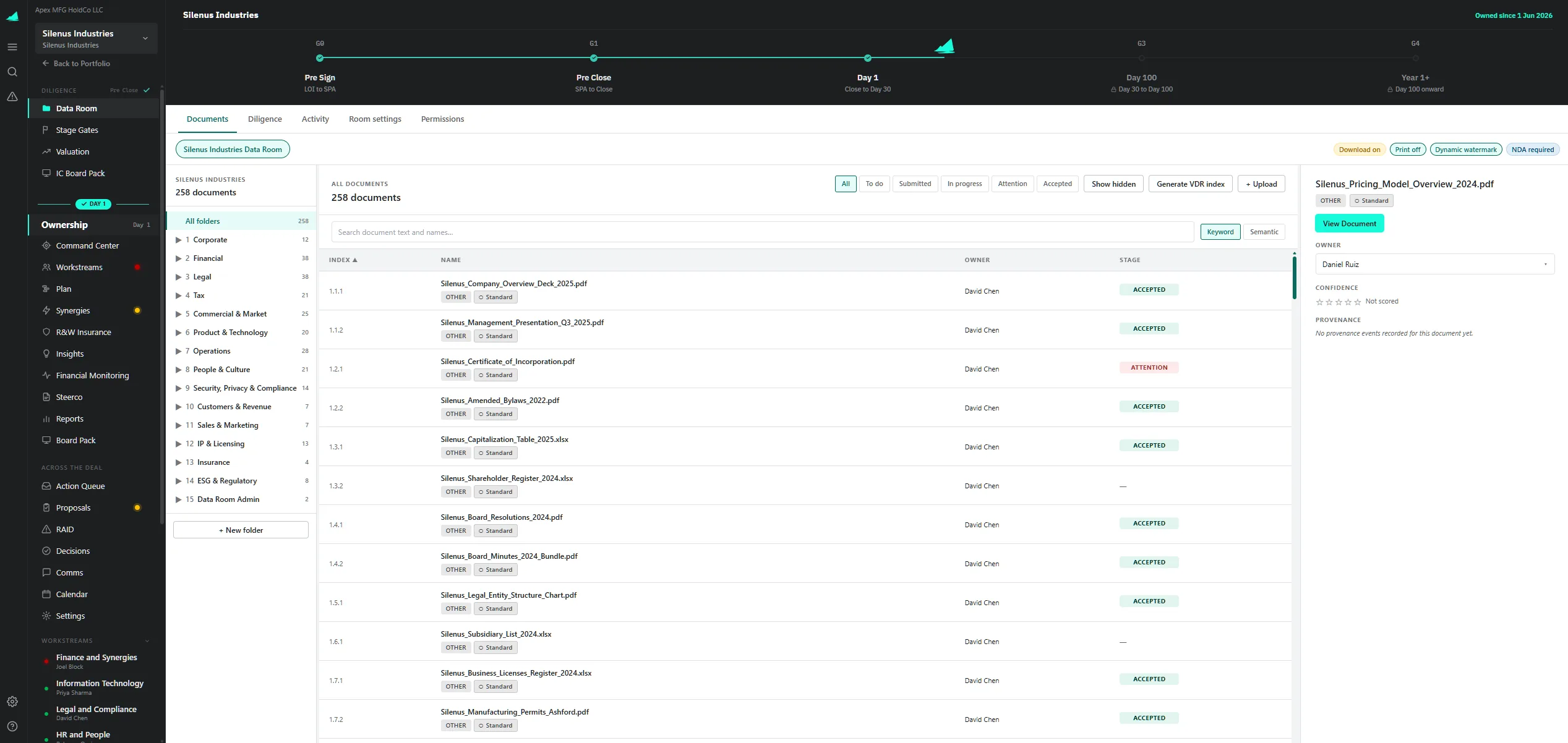
Documents come in and Brink, the intake agent, files each one into a canonical fourteen-domain diligence structure on arrival. Nobody names a folder, nobody drags anything. Text is extracted with a layout-aware model, so tables, financials, and cap tables survive intact instead of collapsing into a wall of characters.

Then the data room becomes something you can talk to. Ask Adrian, the buy-side diligence lead, a question and the answer comes from what's actually in the documents, retrieved by meaning rather than keyword. It'll surface the right clause before an analyst finds the right folder. And every answer respects who's asking: retrieval honors folder permissions and tier limits, so sensitive material never turns up in an answer for someone who shouldn't have it.

Three things worth knowing about how this holds up under pressure. Documents are virus scanned, and anything that isn't clean can't be opened or downloaded. Answers are grounded in the source, with the documents cited. And the diligence structure that gets built here is the same structure the integration plan inherits at close, so nothing gets rebuilt.

Sherpa data room, documents filed into a canonical diligence structure Adrian answering a diligence question grounded in the documents

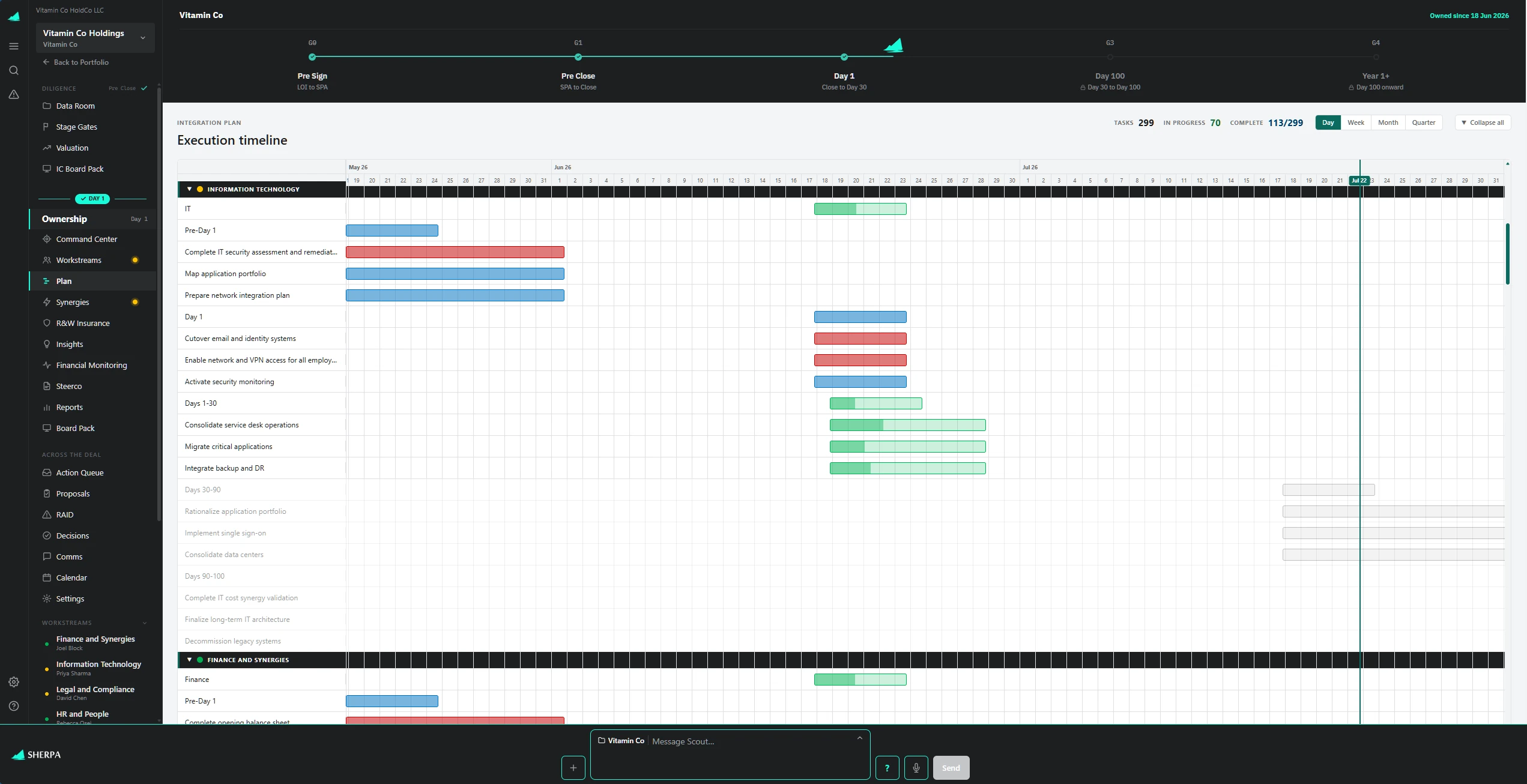
Day 1 is a deadline, not a milestone.

Signing and closing are where an integration is won or lost, because everything you didn't sequence in advance arrives at once. Systems access, banking, contract novation, payroll, branding, the customer email that has to go out at the right hour. Sherpa carries Legal Day 1 and Operational Day 1 as distinct things, because they are, and sequences the work so the difference doesn't catch you flat.

The plan that runs this isn't built from scratch at close. It comes out of the same canonical structure diligence has been filling in, so the work you did testing the target becomes the work you do integrating it.

Sherpa integration plan focused on Day-1 readiness

Sixteen specialists, and one conductor.

Every integration needs a full bench: a banker on the numbers, a CPA on the tax structure, a lawyer on the contracts, an ops chief on the footprint, an ad exec on the brand. Sherpa gives you all sixteen. Warren thinks like a banker. Samantha thinks like a tax expert. Clarence thinks like a deal lawyer who's seen every contract structure there is. These aren't juniors with a job title stapled on, and they've each read every document in the room.

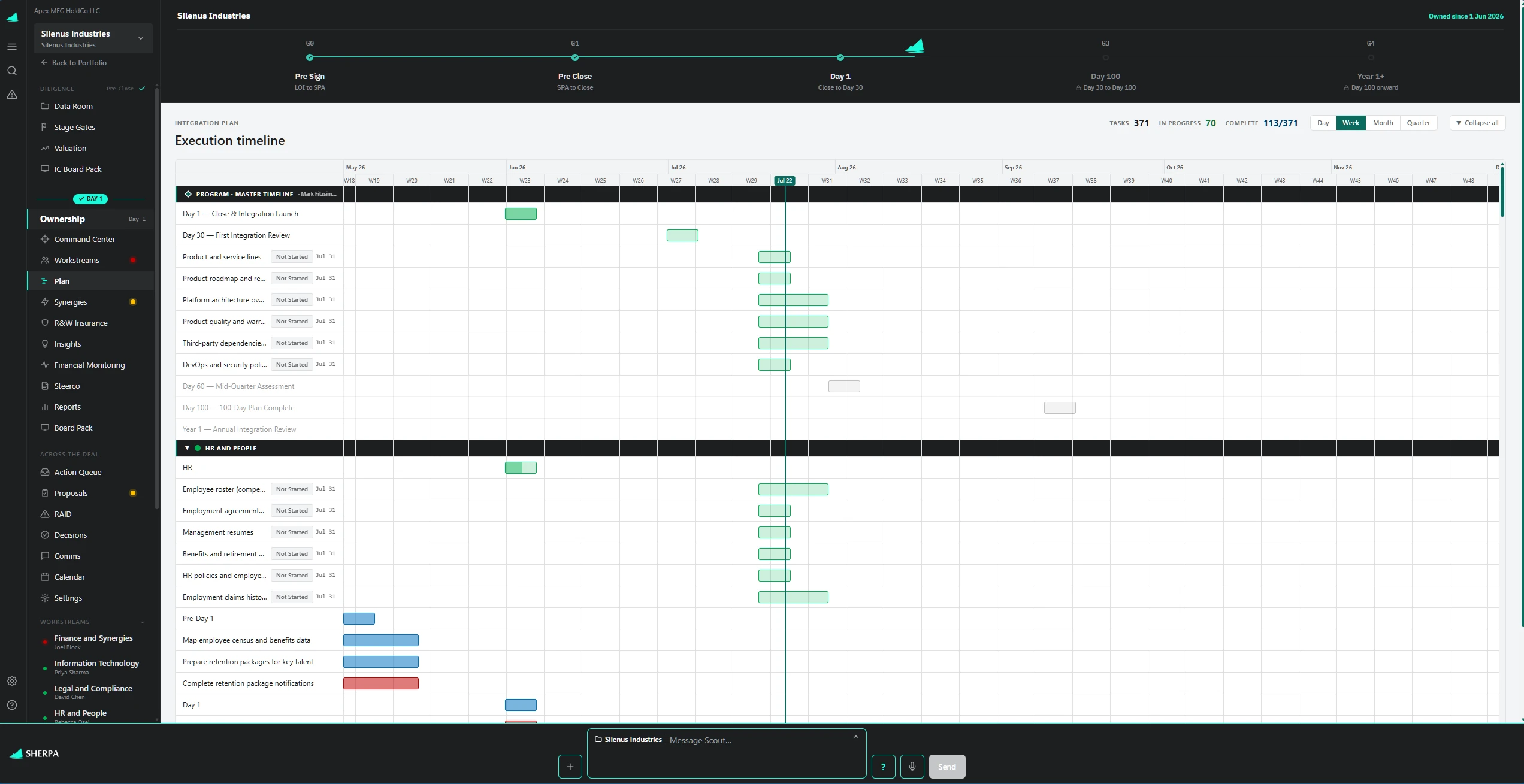
Scout runs them the way a good integration lead does, keeping the workstreams in sync and routing each question to whoever should answer it. The plan spans close to year one on one timeline, and the agents keep their own workstreams current as they work, so the plan reflects what's actually happening rather than the last time somebody remembered to update it.

The governance is deliberate. An agent moves status and progress inside its own lane. Anything structural, adding a task, deleting one, reassigning it, stays your call. It handles the busywork and asks before it touches anything that matters.

The agents keep their own lanes current, but plenty of the work still needs a person. That lands in your action queue: one list, per human, of what's actually waiting on you across every deal you're on. No hunting through workstreams to find out whether something's yours.

Sherpa integration plan spanning close to year one Sherpa specialist agent roster across every workstream

Every dollar, thesis to run-rate.

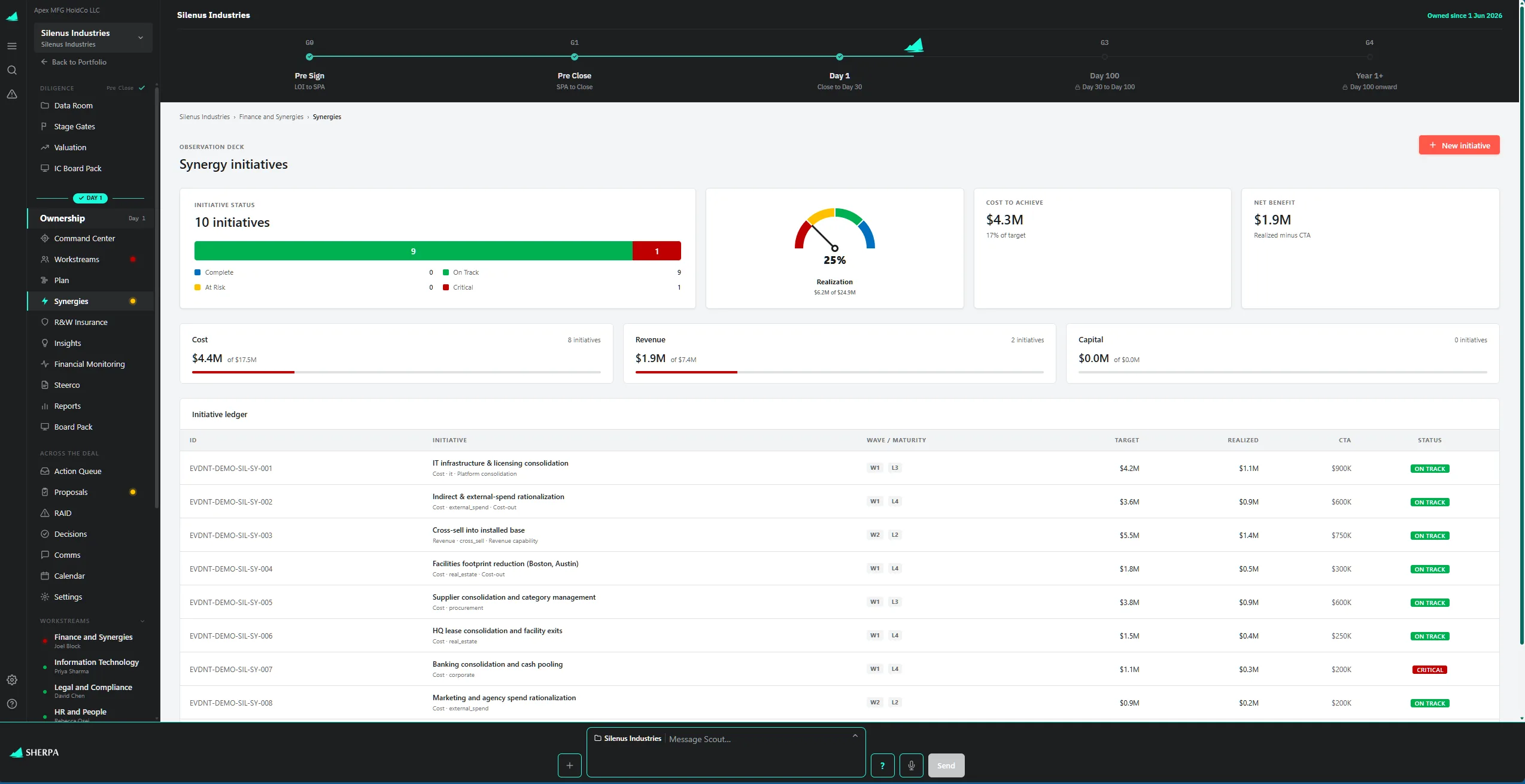
A synergy initiative in Sherpa carries its whole life: the baseline, the targets by year, the run-rate, what it costs to achieve, the net benefit, its maturity gate, and who owns it. You can follow one from a first-pass idea through validation to realized value and prove every step, with the evidence attached.

What makes it real rather than a tracking spreadsheet is that actuals flow in. ERP data lands against the deal model, and when revenue or EBITDA drifts from what the model said, you find out while there's still time to act rather than at the quarterly review. Warren works this lane, watching the numbers against the plan.

It all rolls up cleanly, too. The same initiative feeds the board view, the workstream scorecard, and the post-deal look-back, so there's one number rather than three versions of the truth.

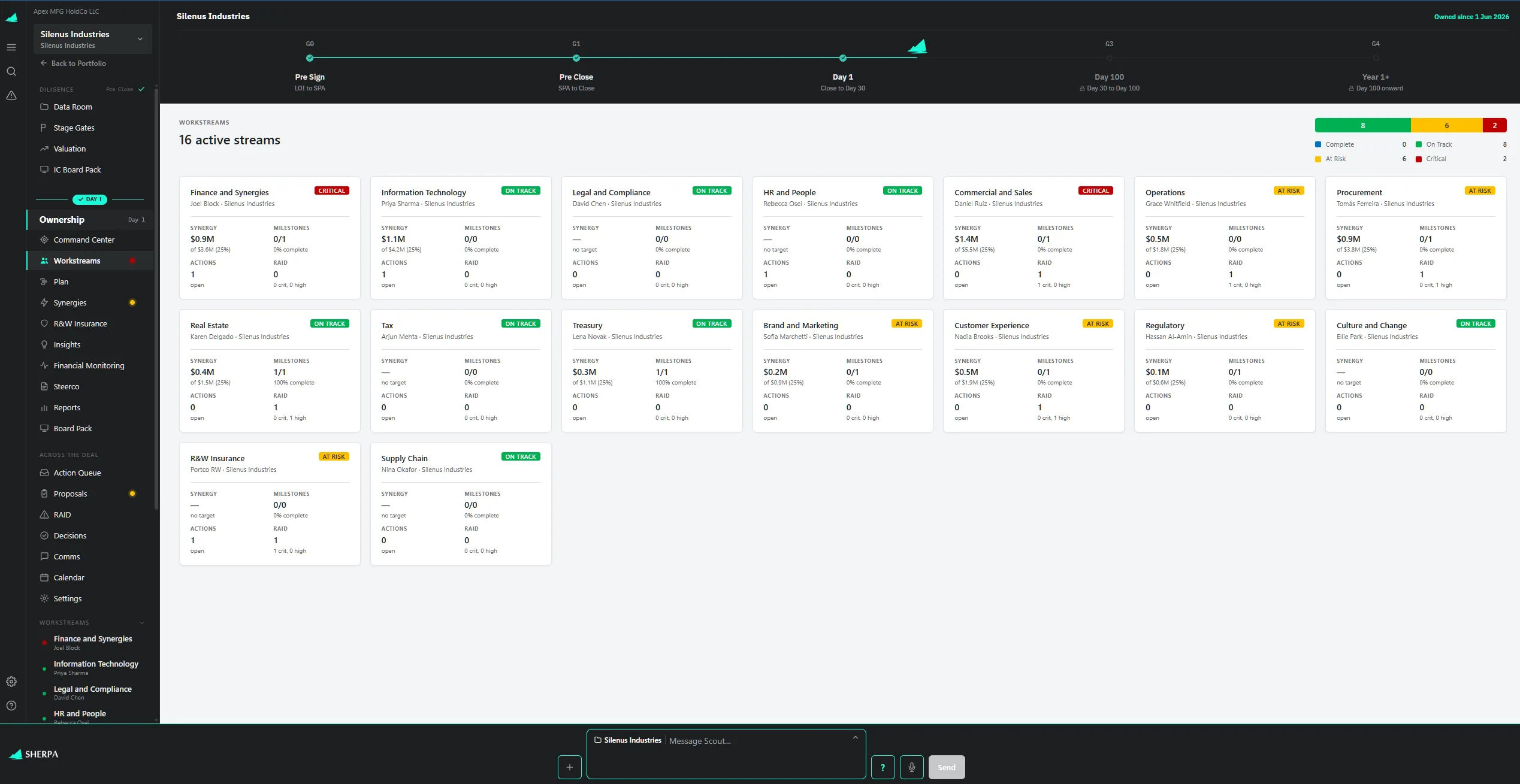
Sherpa synergy tracker, targets and realized value Sherpa oversight view, workstream status and milestones

The policy doesn't stop mattering at close.

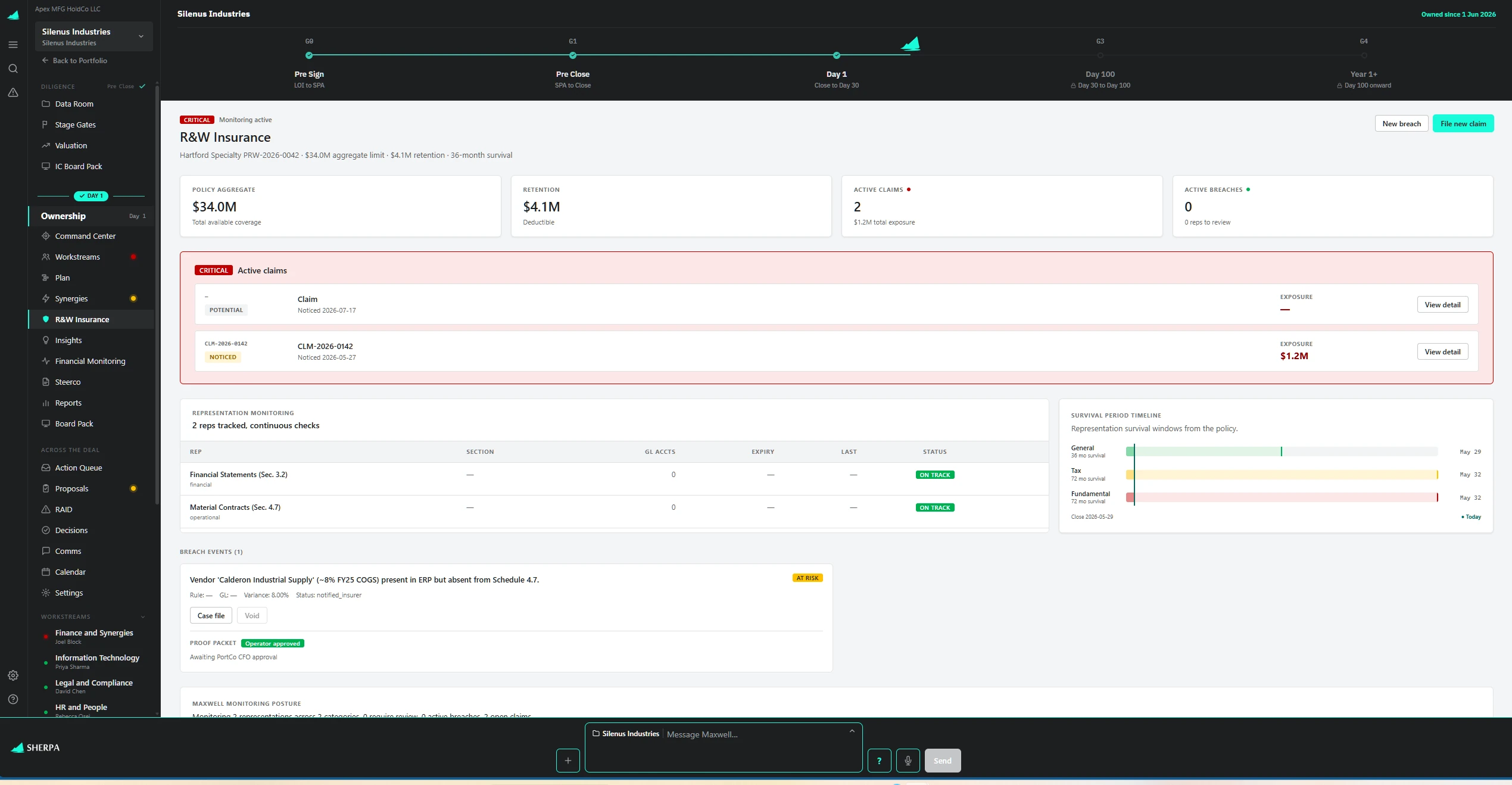
Representations and warranties survive the deal by years, and the exposure sits there whether or not anyone's watching it. Maxwell watches it. The policy, the aggregate limit, the retention, the survival periods on general, tax, and fundamental reps, all tracked on a timeline from close forward.

When something in the business contradicts a representation, that's a breach event, and Sherpa surfaces it with the underlying evidence rather than leaving it for someone to notice during a claims process. The claims register, the notice dates, the exposure, the proof packet, all in one place while the clock is still running.

Sherpa R&W monitoring: policy, claims, representation survival periods, and breach events

And above all of it, Henry.

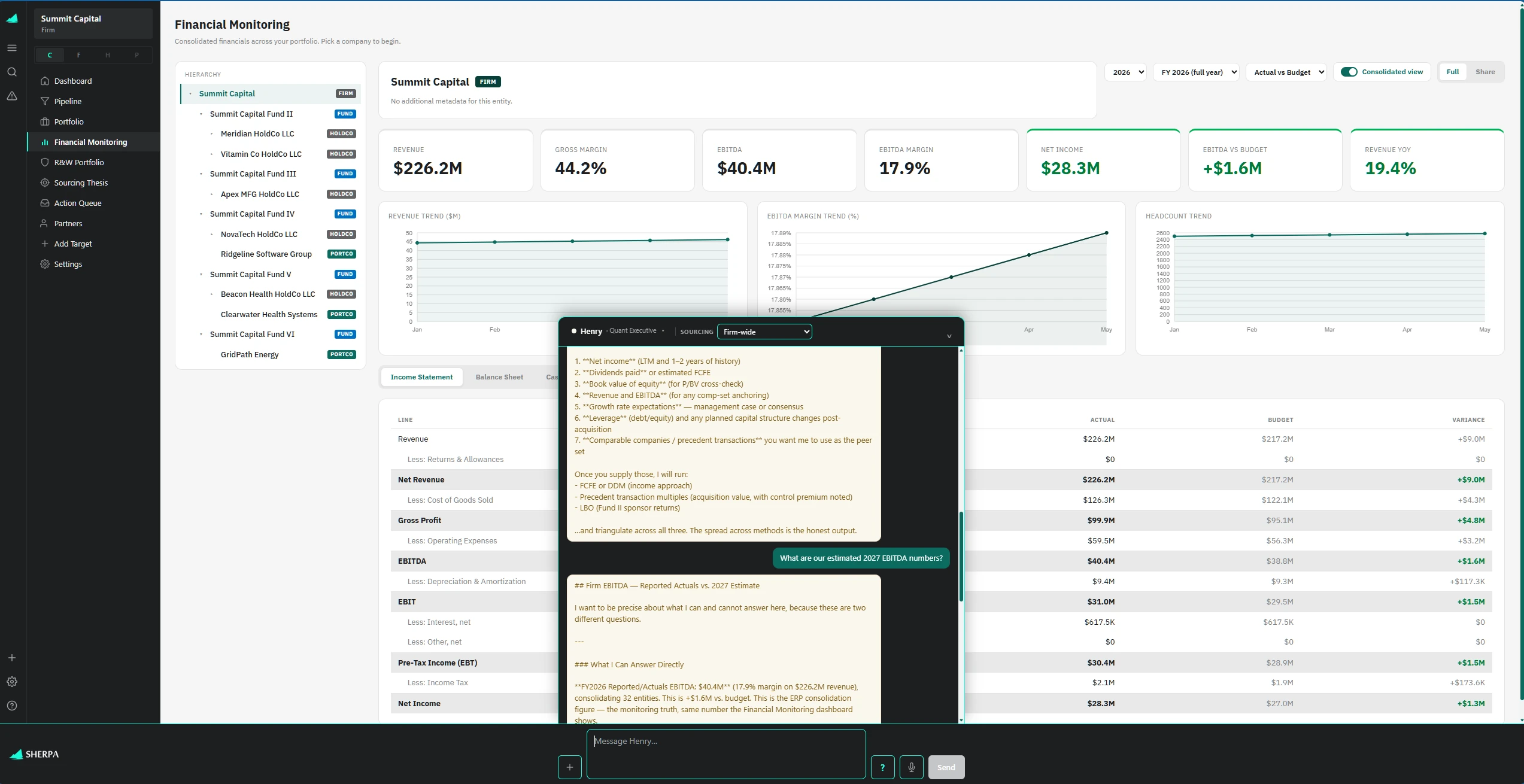
The sixteen work inside a deal. Henry works above them. He thinks like a PE principal, running valuation and capital allocation across the whole portfolio, and the hierarchy is what makes that possible: because Sherpa knows which portco sits under which fund, Henry reads consolidated financials up the tree and tells you what's true at firm level rather than deal level.

That's the whole point of the vertical. The synergies landing, the plans moving, the actuals coming in, all of it resolves upward into a firm-level read on where the value is and where the next dollar should go. Most tools stop at the deal. Henry is the tier above it.

And it compounds. Every integration sharpens the templates and the taxonomy the next deal inherits, your agents build on what your earlier deals taught them, and Henry's read gets better the more of the portfolio he's seen. Your deal teams stay walled off from each other. Your firm doesn't stop learning.

Two-tier agent structure Deal-level workstream agents conducted by Scout resolve upward into Henry at the firm level. Firm level Henry Portfolio valuation and capital Deal level Scout Conductor Finance, Legal HR, IT, Tax Ops, Commercial Eleven more Henry, Sherpa's firm-level quant, reading consolidated financials across the portfolio

Board deck for your 8am? Already built.

Click update and Sherpa pulls the latest plan and the real numbers. Click export and you've got the PowerPoint. Board decks, Steerco packs, financial analysis, ready the moment you need them, because the underlying data is the same data your team has been working in all along. You review it over coffee instead of building it at midnight.

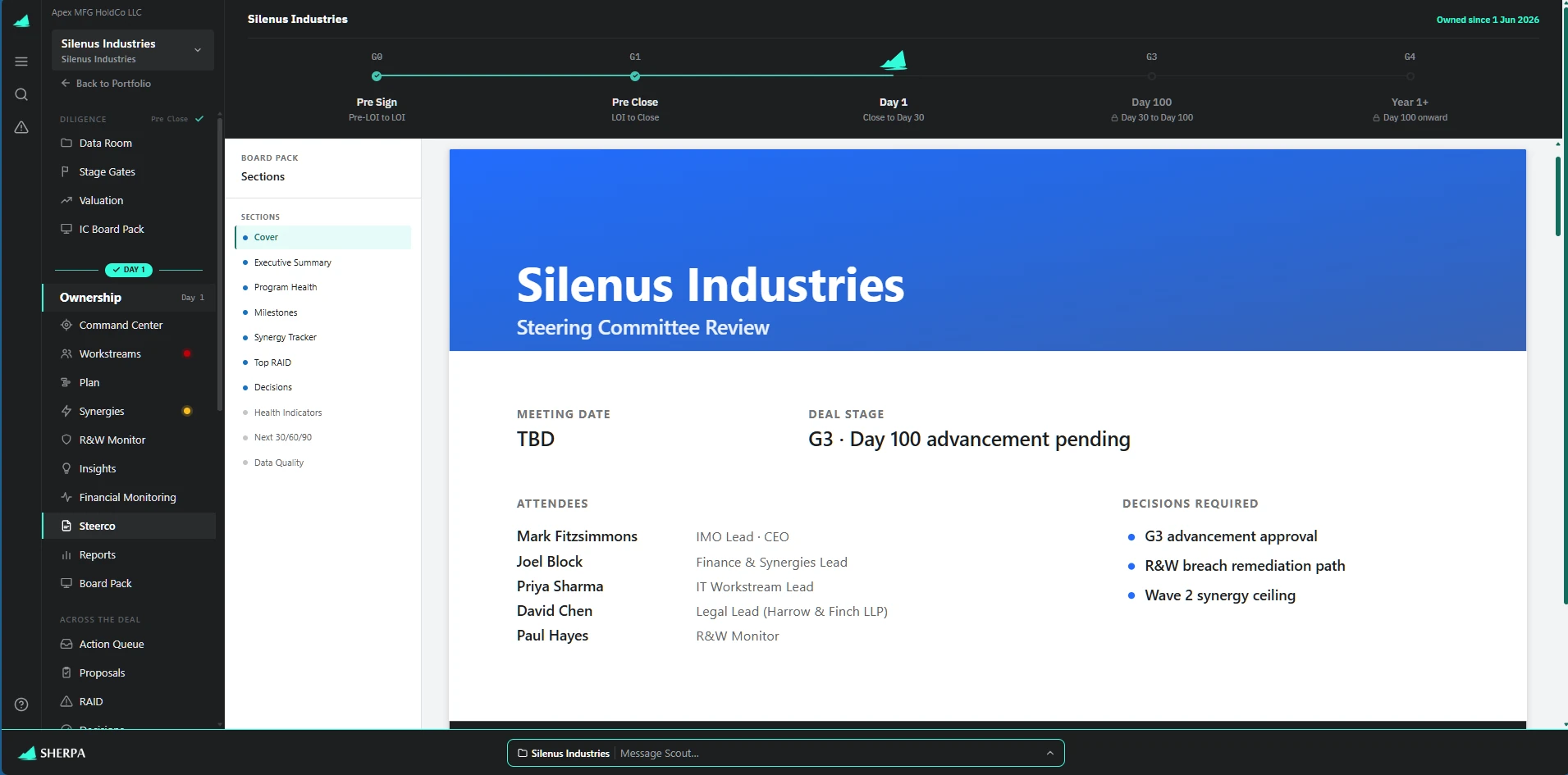
A Sherpa Steerco board pack, generated and ready to export

See the whole arc on a live deal.

Give us fifteen minutes and we'll walk you through Sherpa on a live integration, from the pipeline all the way to the board pack.

Request a demo